
What AIOS Scribe produces for a real video

We chose it because it is short, public, spoken narration, and it quotes famous speeches, which is a case where AI transcription sometimes refuses. This run was made on 2026-10-19 with gemini-3.5-flash; the transcript took 8 seconds. The credit and the video belong to NASA; only the opening is shown here, with a link to the rest.
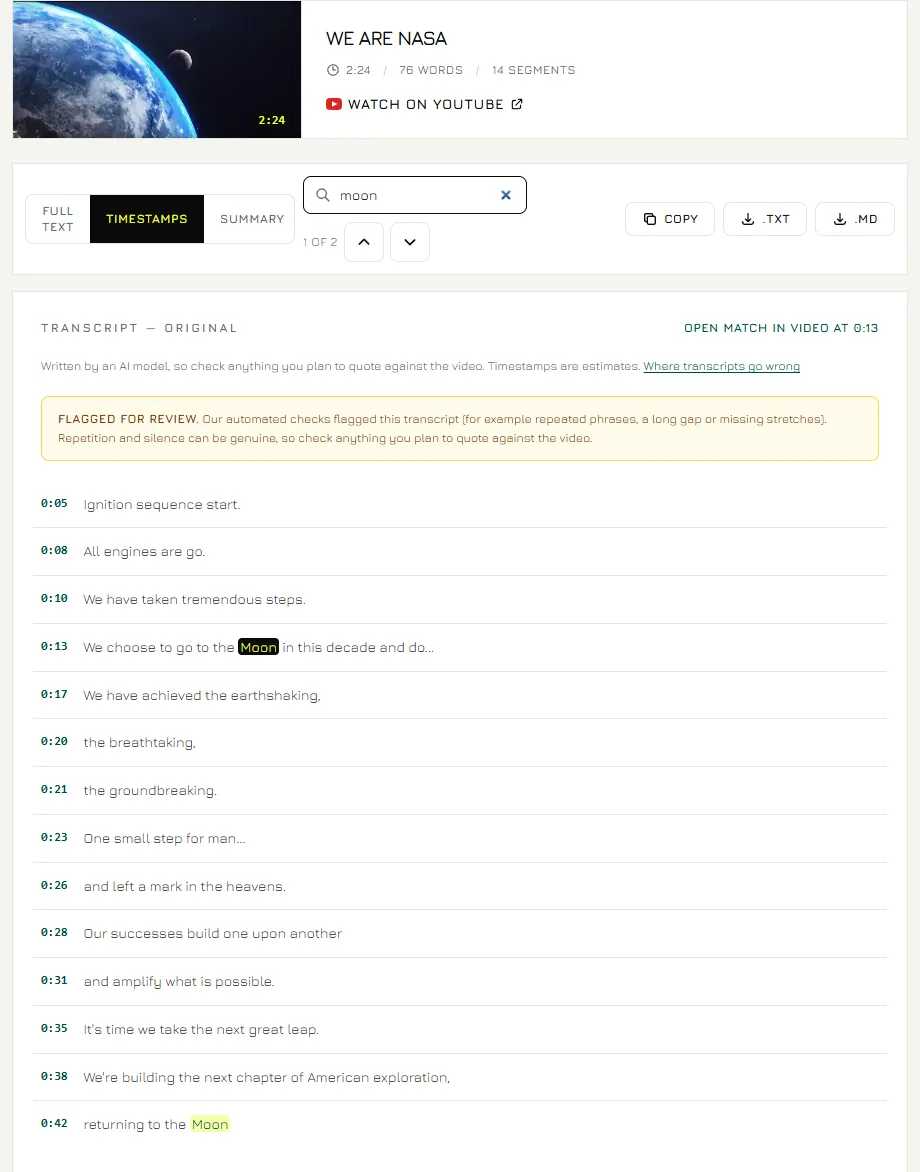
Type a word from the excerpt, for example “moon”. Each timestamp opens the source video at that moment. In the product the search covers the whole transcript.
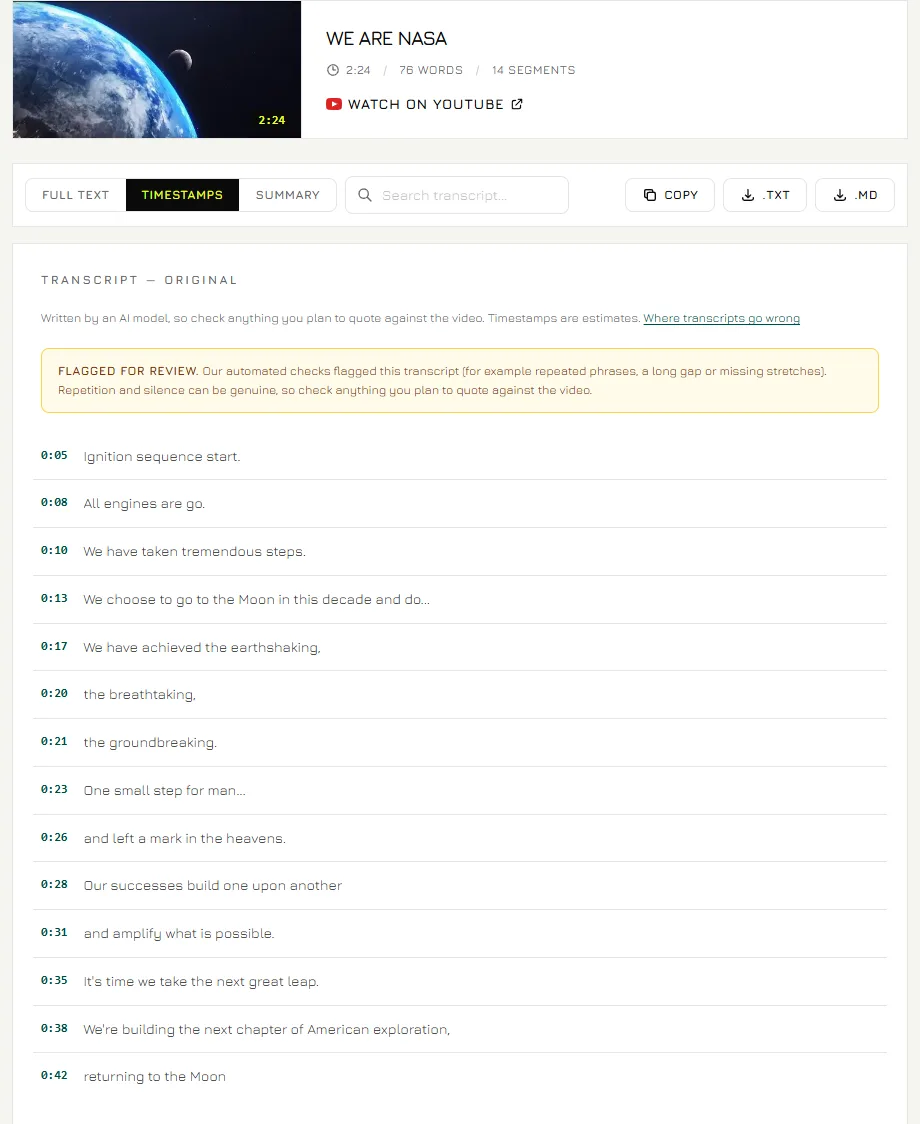
14 lines in this excerpt
- 0:05Ignition sequence start.
- 0:08All engines are go.
- 0:10We have taken tremendous steps.
- 0:13We choose to go to the Moon in this decade and do...
- 0:17We have achieved the earthshaking,
- 0:20the breathtaking,
- 0:21the groundbreaking.
- 0:23One small step for man...
- 0:26and left a mark in the heavens.
- 0:28Our successes build one upon another
- 0:31and amplify what is possible.
- 0:35It's time we take the next great leap.
- 0:38We're building the next chapter of American exploration,
- 0:42returning to the Moon
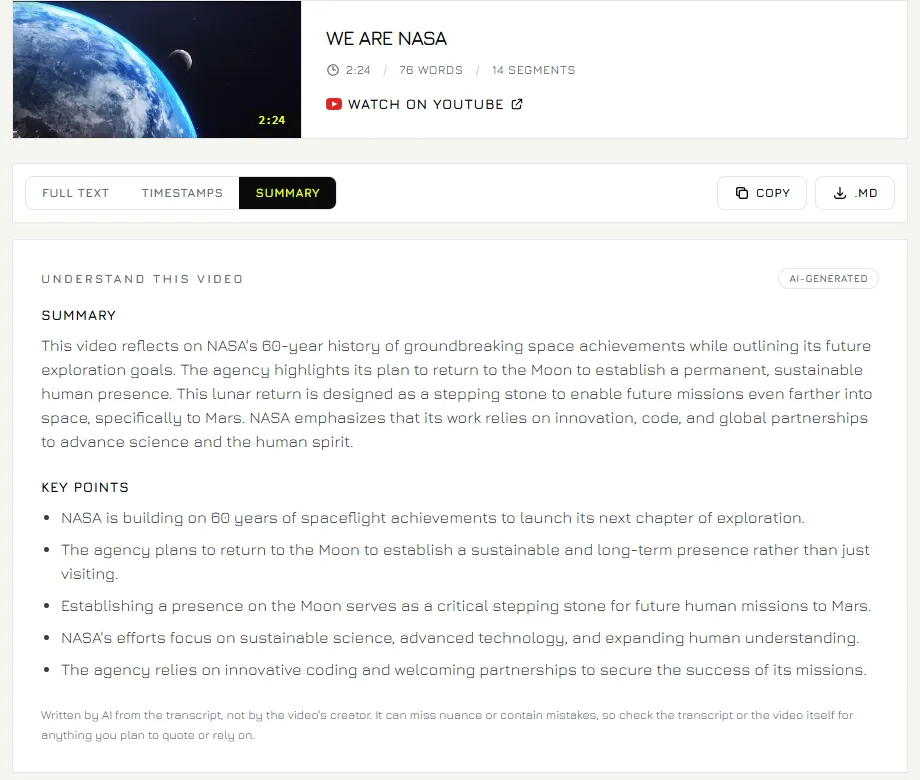
This video reflects on NASA's 60-year history of groundbreaking space achievements while outlining its future exploration goals. The agency highlights its plan to return to the Moon to establish a permanent, sustainable human presence. This lunar return is designed as a stepping stone to enable future missions even farther into space, specifically to Mars. NASA emphasizes that its work relies on innovation, code, and global partnerships to advance science and the human spirit.
- Key point 1NASA is building on 60 years of spaceflight achievements to launch its next chapter of exploration.
- Key point 2The agency plans to return to the Moon to establish a sustainable and long-term presence rather than just visiting.
- Key point 3Establishing a presence on the Moon serves as a critical stepping stone for future human missions to Mars.
- Key point 4NASA's efforts focus on sustainable science, advanced technology, and expanding human understanding.
- Key point 5The agency relies on innovative coding and welcoming partnerships to secure the success of its missions.
Treat the summary as a way in to the transcript, not a replacement for it.
This transcript ended as needs review because of one flag. Every stored transcript goes through the same checks.
- Text is presentNo flag
Text and segments checked.
- Repeated phrasesFlagged for review
Nearby repeated phrases are review signals; the speaker may have repeated them.
Where it looked: 82.6s: to the moon to stay so we can; 82.6s: the moon to stay so we can go
- Timestamps in order and inside the videoNo flag
Timestamp bounds and order checked; synchronization with audio is not assessed.
- Speech speed plausibleNo flag
15-second speech windows above 320 words/minute are flagged. Long segments or unspaced scripts leave this unassessed. This is not an audio alignment score.
- Speech covers the videoNo flag
Gaps and last-speech position are signals only: silence, music or an outro can explain them.
The repetition flag shows why a flag is not an error: a speaker can say a phrase twice on purpose, and we did not listen to this passage to find out. That is what the flag asks a reader to do. The same checks decide whether a transcript is held back; see how we evaluate transcription quality and where AI transcripts go wrong.
These are screenshots of the real transcript page, rendered with this example's excerpt in place of a live result, so the counts shown (words and segments) are for the excerpt, not for the whole video. The site header and the translation card are left out of the frames.
- It is one video. It says nothing about accuracy on your audio, and we have no audio-verified accuracy figure yet.
- It is a snapshot from 2026-10-19, not a live call. A new run can come out differently.
- Speaker names are not added, and the summary is not part of the downloaded transcript.
Public videos of up to two hours, with a free account.